
Somewhat Scary

Anxiety, uncertainty, and fear do not necessarily mean we are going the wrong way. Sometimes they are part of the energetic and psychological cost of entering a larger domain. They are intrinsic to the experience, making it special, healing, unique, and powerful.

Going Somewhere New

I am not a big traveller, for fairly typical reasons. There have been children to raise, not enough money, or money was prioritised for other choices like dancing. Also, as a not particularly practical person, travelling on my own seemed stressful because there are many details to remember. You have to book things, get yourself to the right place at the right time, make sure you have everything you need, and generally manage all the little but essential details.

Still, life changes and we change. I decided to go on an adventure. At the top of my list was Uluru. The vast landscape, the changing sky, the colours, the silence — when you can get away from the tourist packs — and the sheer ancient presence of the place are transformative. Not just beautiful, but powerful.

However, such adventures tend to come with their own set of challenges.  Things that can be somewhat scary.

Getting There

I had booked airport parking and made sure I had the QR code I needed to get in. I drove to the airport, found the parking area, got to the machine, and then couldn’t figure out where to put my phone so the machine could read the code. This sort of thing can make me panic, as if some part of my brain is saying that my whole carefully organised trip is about to fall apart because I cannot work out how to get into the airport parking.

“Calm. No need to panic. Listen for the answer.”

Then I realised there was a call button.

I pressed it, a person answered, and told me where to put the phone. It was quite obvious really. First challenge resolved.

I had made sure to get a window seat because, although I do not like planes or being packed in with lots of people, I love looking out the window. By random chance, I was given one of the free special-order meals. I was hungry as I had not eaten. Moreover, it was vegetarian and edible. A little reminder from life that everything would come together perfectly in spite of any seeming setbacks.

At Ayers Rock Airport, the shuttle bus driver taking us to the resort was extraordinarily rude and seemed perpetually on the verge of exploding. He complained about practically every bag he had to put into the bus. He didn’t even direct his negativity at annoying people.

One polite man had particularly heavy luggage, and the driver would not let it go. He kept asking, in a condescending way, what on earth he needed that was so heavy when he was staying at such a beautiful resort, as though the fact that the man could afford to stay there somehow made his heavy luggage even more offensive. Everyone looked surprised but somewhat meek, as we were dependent on him to get us there, cranky or not. 

Even grumpy-bum shuttle driver became part of the experience: a reminder that we were no longer moving around in our usual, familiar worlds, where there are nearly always other options. There weren’t.

Going Remote

The accommodation for Uluru is not at the rock itself. All the hotels are in the resort village and run on a bus system. Every activity has to be booked separately, and you have to make sure you are on the right tour bus to get anywhere and at the right pick-up spot to get back. You definitely would not want to miss the bus back and find yourself stranded at Uluru or Kata Tjuta. It all seemed complicated and stressful. 

But the challenge of it was part of what makes visiting somewhere like Uluru-Kata Tjuta special. You are being granted the privilege of entering a vast, remote, ancient landscape of enormous cultural and spiritual significance. The organisation is there for a reason. The distances are real. The remoteness is real. In the warmer months, the desert heat is dangerous. You are going somewhere special enough that you cannot simply wander in and out without thought. You have to prepare, pay attention, and respect the conditions of the place. The very things that make the experience somewhat stressful are also part of what makes it feel significant.

Besides, once I understood how the system worked, it all made sense.

First Day Challenge

On my first day at Uluru, I planned to walk from one part of the rock to the Mutitjulu Waterhole before heading back to the pick-up point. That was the route the tour guide had suggested for me. The trouble was, the walking time she gave me was based on an ordinary-paced walker. My legs are short, and for some reason I have always been a slow walker, so it ended up taking me much longer than she said.

I kept passing people coming the other way, and I asked how far it was. They all said not far, a bit longer. But I didn’t seem to be getting any closer. Time was ticking away, and I knew I had to get back to the pick-up bus on time. I told myself to walk faster. I tried taking bigger steps, and then my feet started hurting, getting pins and needles, and not working properly. That night, I realised my socks had been too tight, cutting off circulation, but I didn’t know it at the time. 

Eventually I reached Mutitjulu Waterhole, and it was spectacular. While I was there, three Aboriginal girls were also there. There is an Indigenous settlement of about three hundred people close to Uluru, and unlike everyone else, they can move around freely. The kids jumped over the ropes, disappeared into a cave, and I could hear them inside laughing and moving the dirt around. They were at home. And I still had time to get back to the pick-up point.

The difficulties are part of the experience. If it were easy to walk long distances through that landscape, it would not carry quite the same impact. We are more receptive to its scale and power because we are not insulated from the environment. The body’s vulnerability is part of what makes us conscious of where we are. The challenge did not detract from the gift. It was part of it.

Gorgeous Gorge

The next morning began very early because I was going out to Kata Tjuta for sunrise. The bus left at 5:40 a.m., so the first small worry was making sure I didn’t oversleep and miss it. Because of my experience the day before at Uluru, I was also nervous about the walk into Walpa Gorge. I did not know how difficult it would be, and I worried that I would not be able to walk fast enough to get in and out in the time we had.

By the way, I discovered that the bus drivers had everybody’s names and wouldn’t leave you stranded in the National Park. So that took care of one worry.

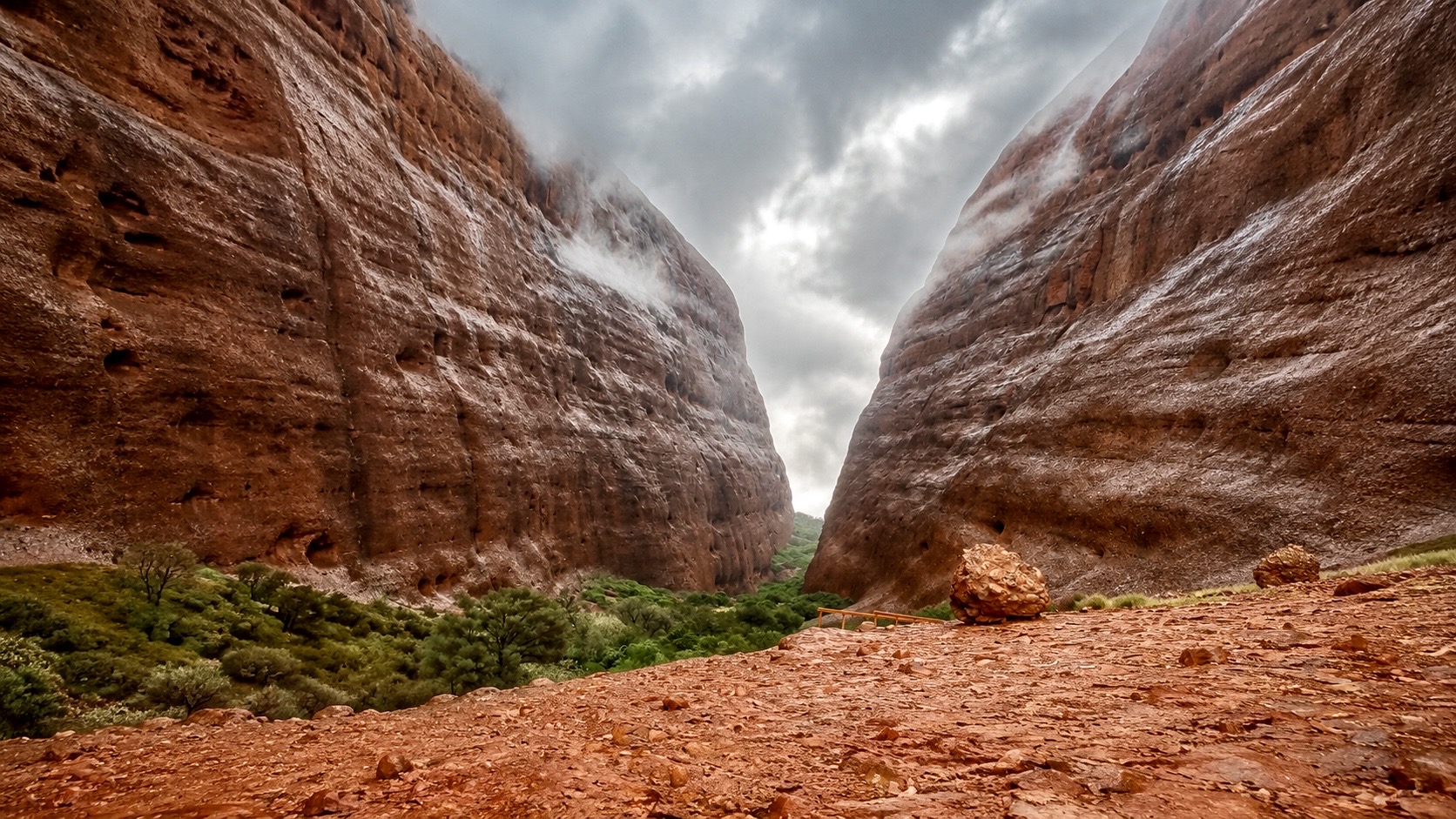
The weather at Kata Tjuta that morning was cold, wet, and very windy, which is fairly unusual for the area. The walk into Walpa Gorge was over rocks and between two enormous steep sides that created a wind tunnel. Perfect for the wild elemental environment.

When we started, I was at the back of the group. But then people started stopping and returning to the bus, probably because it was so cold, wet, and windy. But it wasn’t as cold as the weather I’m used to in southern Australia. So, I kept going and ended up not only at the front of the pack but as a lone wolf in the gorge with no one in sight. Divine. 

I wasn’t frightened of getting lost because there was only one way in and one way out! I knew that much. And now that I understood the bus would not abandon me, I could walk much more confidently. What a treasured moment. The “bad” weather was what gave me the gift of being there alone. The very difficulty was what gave me the treasure.

Flying High

Later that day came the helicopter ride over Uluru and Kata Tjuta. I had been so busy booking activities and enjoying them that I hadn’t given the helicopter ride any thought. In fact, I wasn’t worried about it at all. Unlike the walks, where my body had to manage the environment, someone else was going to do all the work and move me around. 

Then the helicopter started to wobble its way off the ground, and suddenly the whole thing seemed somewhat scary. It was much bumpier than I had imagined, and every time we turned, the whole thing leaned over to the side. We were suspended high above the ground in a small, bouncing glass bubble.

Incidentally, at the end, I asked the other three passengers whether they had been scared. They all said no. One of them was a young man of about twenty. He was not scared because young people do not grasp their own mortality. The other two were a wealthy older couple, so perhaps they were not scared because money gives people the comforting illusion that mortality is negotiable. Or maybe I am just a scaredy-cat.

The morning’s “bad” weather had cleared just in time. The conditions were spectacular for flying, and the helicopter ride was magnificent. Seeing Uluru and Kata Tjuta from the air, the immense scale of the land, and the distant rain moving across the desert were all the more heightened by my awareness of physical vulnerability.

Home and Away

Home day arrived. I was not particularly looking forward to another encounter with grumpy-bum airport shuttle driver. Sure enough, a bus pulled up, and the driver jumped out, unloading people and almost throwing their suitcases down. Many of us were waiting nearby to get on as he kept barking at people to stay where they were.

We all stood there patiently for about ten minutes while he unloaded the passengers and their luggage. Only when he had finished did he decide to tell us, with the air of explaining something obvious to the stupid, that he was not taking us to the airport. He was only dropping people off.

Then he pointed towards another shuttle approaching in the distance. Fortuitously, this driver was a different kettle of fish.

“Not to make you anxious,” he said in a very serious tone, “but I’m sure you’ve noticed it’s quite busy this morning.”

Everyone was quiet.

Then he added, “It normally takes me six minutes to get to the airport, but with this sort of traffic, it might take me, ah … I don’t know … maybe six minutes and ten seconds.”

Everyone laughed.

Old mate, grumpy-bum added tension to a situation in which we were dependent on him, while this man relieved it. He made the journey light.

Part of the Gift

Instead of thinking that the things which make us afraid or anxious are negative and should be removed from our experiences, we can incorporate them into the experience itself. Without them, the experience may not be quite the same.

If I had not been concerned about waking up earlier than usual for my initial flight to Uluru, it would not have had that feeling of setting off on a special adventure in the “middle of the night”. If I had not needed to be organised about the airport parking, the QR code, the flight, and getting myself onto the plane, I might not have been so conscious of flying halfway across the country into the middle of a vast continent.

If I had not needed to keep track of all the buses, pick-up points, and return times at Uluru and Kata Tjuta, I might not have been so aware that these are remote and extraordinary places where being left behind really could become a serious problem. If the helicopter had felt as safe as sitting in my lounge room, I might not have had the same visceral awareness that I was suspended high above the ground in a glass bubble, looking down on one of the most remarkable landscapes in the world.

The anxiety is not always something outside the experience that needs to be got rid of. Often it is part of what tells us: this is special, this matters, pay attention. Do not take it lightly. Do not take it for granted.

Sometimes, of course, fear is useful and something really is unsafe. But often the difficulty is simply part of the experience.

A challenge is not by nature a negative thing. It is something to work with. We can look for an idea. We can ask somebody. We can press the call button. We can learn how the bus system works. We can discover that our socks were too tight. We can keep walking when everyone else falls by the wayside and find ourselves in a completely different and astounding world. The somewhat scary helped lead us there.

—Consciousness Continuing


Discover more from Donna Goddard

Subscribe to get the latest posts sent to your email.

Leave a comment